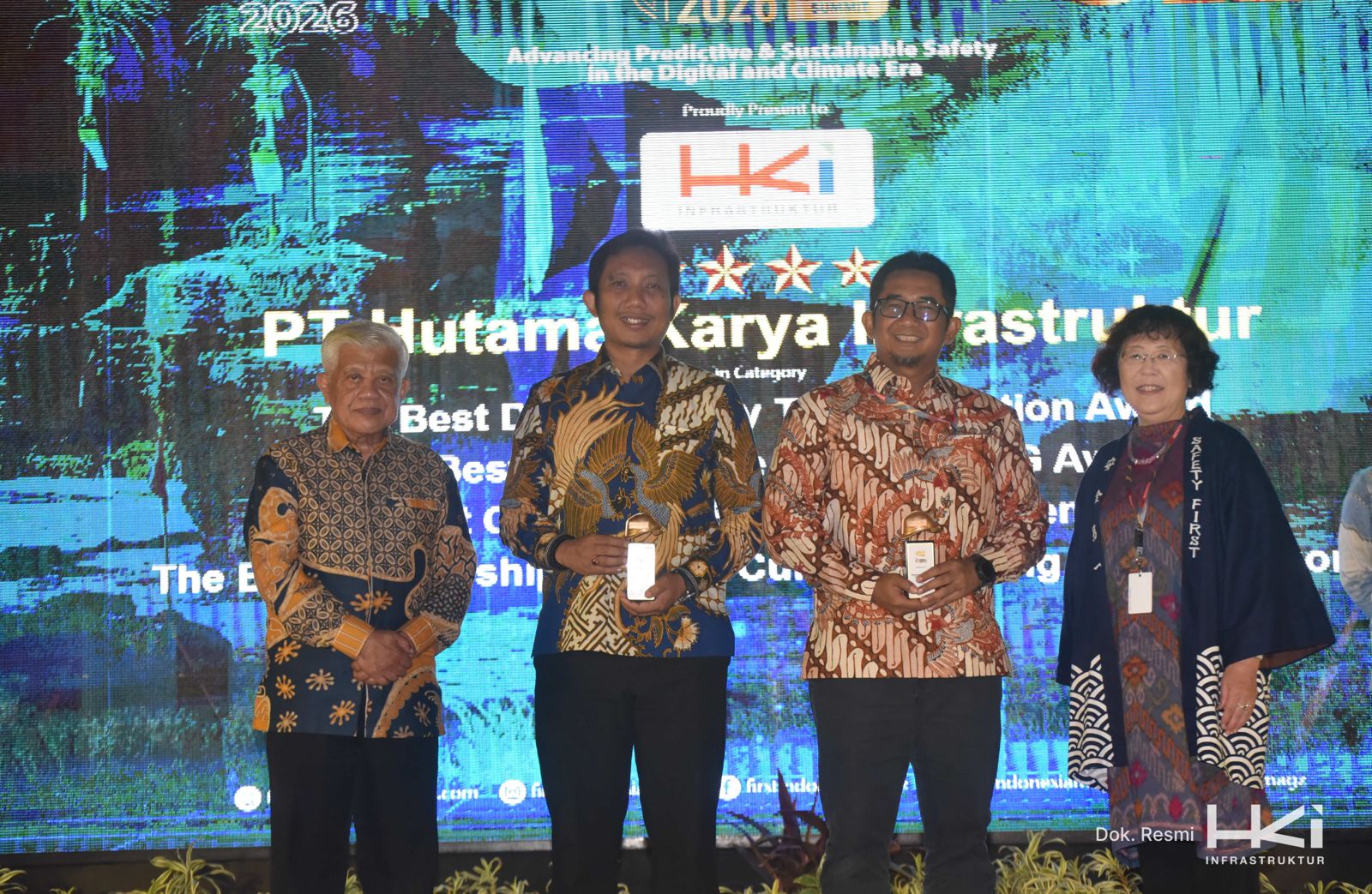


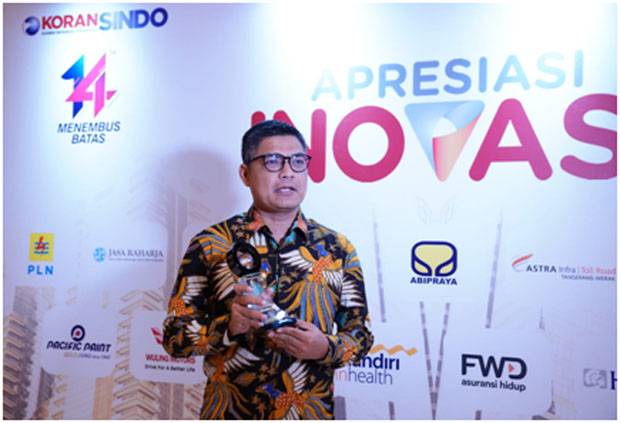
On Wednesday, July 31, 2019, PT Hutama Karya Infrastruktur (HKI) won an award at the Innovation Appreciation event organized by Koran Sindo and Sindonews.com in the "Best Product" category. This award was given to HKI for successfully implementing the Lean Construction method in one of its projects. The innovative working method was applied by HKI to the Trans-Sumatra Toll Road (JTTS) project, specifically in the Pekanbaru-Dumai Section 2A.
The Lean Construction method applied by HKI on part of this project has proven to increase productivity and efficiency, both in terms of time and cost. Before the implementation of Lean Construction, the tunnel structure work in the Pekanbaru-Dumai Section 2A project was facing delays from the master schedule, along with various inefficiencies.
“HKI has clearly implemented Lean Construction in several steps, including identifying delays and analyzing the work breakdown structure (WBS) in the early stages (current state map) to understand the causes of delays or inefficiencies in the remaining work. Additionally, it’s important to identify and eliminate waste, followed by the application of lean tools and cash programs for time and cost, resulting in a new work process (future state map),” explained Mardiansyah, Head of the Control Department at HKI.
In a separate statement, Aji Prasetyanti, President Director of HKI, expressed his appreciation for this award. “Given the ambitious targets set for HKI, we can no longer achieve them with the old methods. The implementation of Lean Construction in part of the Pekanbaru-Dumai 2A project is an innovation that must be scaled across all of HKI’s projects,” Aji said. She further emphasized that this ambitious target is a reflection of shareholders’ confidence in HKI’s continued positive and exponential growth. “This year, we are targeting revenue of IDR 13 trillion and net profit of IDR 1.17 trillion. Insha Allah, with a united team and innovations in various areas like Lean Construction, we are optimistic about achieving these goals,” she concluded.
About PT Hutama Karya Infrastruktur (HKI)
PT Hutama Karya Infrastruktur is a subsidiary of the state-owned enterprise PT Hutama Karya (Persero). Established in 2015, HKI was created to maximize the benefits of the assignment given by the Indonesian government to PT Hutama Karya (Persero) in the development of the Trans-Sumatra Toll Road (JTTS).
Since 2015, HKI has continued to record impressive corporate performance. By the end of 2018, HKI had a Compound Annual Growth Rate (CAGR) of 143.32% in revenue and 138% in net profit. This is due to the increasing acquisition of contracts for JTTS projects entrusted to HKI, along with its ability to produce high-quality toll road construction work.
To date, HKI has successfully completed the JTTS Palembang-Indralaya section (22 km), the Medan-Binjai Section 2 from Helvetia to Sei Semayang (6 km), and Section 3 from Sei Semayang to Binjai (4.5 km). Currently, HKI is constructing the JTTS Pekanbaru-Dumai section (131.4 km), which is expected to be completed by the end of 2019, as well as the Padang-Sicincin section. Additionally, HKI has secured new contracts for the construction of JTTS Pekanbaru-Bangkinang, Indralaya-Prabumulih, and Bengkulu-Taba Penanjung sections.
With ongoing JTTS construction plans extending for years to come, HKI continues to innovate across all business sectors, aiming to enhance operational efficiency and effectiveness, ultimately optimizing value for shareholders and other stakeholders.
About Lean Construction Method
Lean Construction is a method for designing construction project work systems that can identify waste (inefficiency) so that anything that does not add value can be minimized or eliminated. The goal of applying Lean Construction is to optimize project execution, considering common obstacles such as material delays, ineffective human resources, and waste management issues, which often hinder the smooth completion of projects.
Although Lean Construction is not yet widely implemented in Indonesia’s construction industry, due to its relatively unfamiliar principles, its positive impact can be significant when applied correctly. Benefits include improved performance, safety, and ultimately, more cost-efficient project execution.