

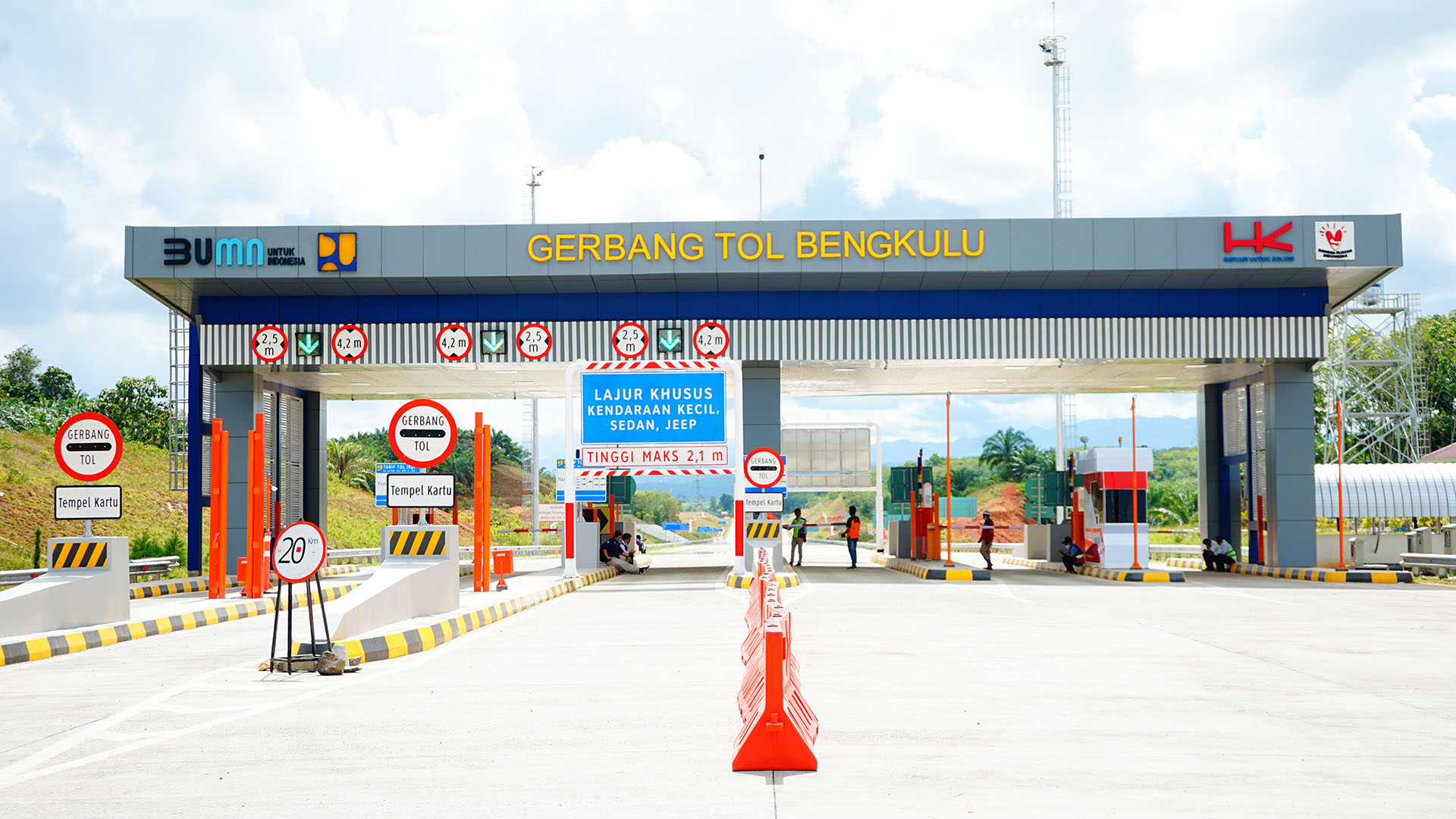
Bengkulu – The Trans Sumatra Toll Road (JTTS) section of Lubuk Linggau – Curup – Bengkulu, specifically the Bengkulu-Taba Penanjung section, has reached 100% construction progress. The toll road, built by PT Hutama Karya Infrastructure (HKI) since 2019, underwent a Function Feasibility Test (Uji Laik Fungsi - ULF) on April 13-14, 2022, and is now awaiting an operational feasibility letter from the Ministry of Public Works and Public Housing (PUPR) before it can be opened for operation.
Stretching 17.6 km, the Bengkulu-Taba Penanjung Toll Road is the first toll road in Rafflesia Land. Connecting the city of Bengkulu and Taba Penanjung, this toll road is designed for a speed limit of 80 km/h, which will shorten travel time to approximately 15 minutes from Bengkulu to Taba Penanjung. In contrast, using the national road, travel time can reach up to an hour.
The toll road will implement a one-gate system, with a single tapping at the GT Bengkulu in Betungan. The toll road features 21 bridges, two intersections, and one interchange.
Construction Cutting Through Hills, Crossing Valleys, and Rivers
The topography of the Bengkulu-Taba Penanjung Toll Road presents significant challenges, requiring the team to ‘cut through hills’ and build bridges – pile slabs to cross valleys and rivers. As a result, hillside cuts along the toll road form slopes with varying heights, the highest reaching approximately 45 meters. The toll road has a considerable number of bridges, including two long bridges with nine spans, each approximately 300 meters in length.
To prevent landslides, the slopes are constructed with a trap system, where each trap has a height of approximately 5 meters. Additionally, vegetation is planted to prevent erosion from rainfall, slow down surface water flow, maintain soil porosity and permeability, stabilize the soil, and reduce pore water pressure through transpiration. The type of vegetation planted depends on the soil type: solid sodding for red soil, hydroseeding for white napal soil, vetiver grass for red soil with slopes >1:2, and stone masonry for black napal soil. “Slope protection is crucial on the Bengkulu-Taba Penanjung Toll Road project to prevent erosion, which would affect the toll road’s operations later on,” said Selo Tjahjono, Director of Operations III.
Given the soil types and terrain, the bridge foundations use various deep foundation types, such as bore piles and concrete piles. Construction had to be carried out from the valley base or riverbanks, resulting in high bridge columns. This also influenced the bridge girder erection method, which is done using a crane and a combination of cranes with a truss launcher girder. For faster pile slab construction, a precast method was used for the floor slabs.
Throughout the project, HKI regularly coordinated with PT Hutama Karya (Persero), the Ministry of PUPR, and various experts in their respective fields to ensure the quality, schedule, and costs were properly controlled.
Selo hopes that once the Bengkulu-Taba Penanjung Toll Road is open to the public, travel time between Bengkulu and Taba Penanjung will be significantly reduced. “We are committed to delivering high-quality infrastructure, especially toll roads, for the benefit of the public. This is HKI's commitment to supporting the success of the Trans Sumatra Toll Road development,” he concluded.